Understanding Chat Agents for Business: The 2026 Guide that explains what they are and why you need to be involved in the latest dynasty
Post by Peter Hanley coachhanley.com
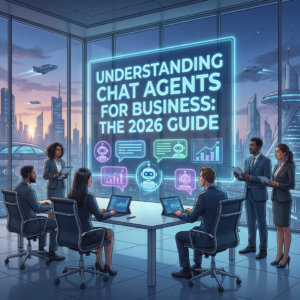
Understanding Chat Agents for Business: The 2026 Guide
The era of the “frustrating chatbot” is officially over. In 2026, we have transitioned into the age of Agentic AI—systems that don’t just talk, but actually do. For businesses, this means moving beyond simple FAQ responses to autonomous agents that manage entire workflows, from processing refunds to hyper-personalized sales journeys.
The Evolution: From Chatbots to AI Agents
Modern business agents are categorized by their “reasoning” capabilities. Understanding where your needs fit is the first step toward successful implementation.
| Agent Type | Capability | Best For… |
| Reflex Agents | “If-This-Then-That” logic. | Simple FAQs, order tracking. |
| Goal-Based Agents | Acts with a specific outcome in mind (e.g., booking a demo). | Lead qualification and scheduling. |
| Learning Agents | Adapts behavior based on feedback and past data. | Personalized shopping assistants. |
| Multi-Agent Systems | Multiple AI units collaborating on complex tasks. | End-to-end supply chain management. |
Key Benefits for the 2026 Landscape
- Hyper-Personalization: Agents now possess “long-term memory,” recognizing a customer’s history across email, WhatsApp, and live chat without the user ever having to repeat themselves.
- Proactive Engagement: Instead of waiting for a query, 2026 agents use predictive analytics to reach out when they detect “digital body language” that suggests a customer is struggling at checkout.
- Omnichannel Fluidity: A conversation can start on an Instagram DM and seamlessly transition to a voice call with all context preserved.
Avoiding the “Hallucination Cycle”
One of the biggest risks in the 2026 AI landscape is the Hallucination Cycle. This occurs when an AI lacks specific data but attempts to “help” anyway, leading to fabricated answers.
The Cycle: User Query $\rightarrow$ Data Gap $\rightarrow$ AI Fabricates Answer $\rightarrow$ Customer Frustration $\rightarrow$ Brand Damage.
To break this cycle, businesses are now implementing RAG (Retrieval-Augmented Generation), which forces the AI to check a verified “Knowledge Base” (like your company’s internal PDFs or CRM) before answering.
Implementation Strategy: The “Human-in-the-Loop” Model
Success in 2026 isn’t about replacing humans; it’s about augmentation.
- AI as the “Front Line”: Handles 80% of routine queries instantly.
- Human as the “Expert Supervisor”: Steps in for complex emotional issues or high-value negotiations.
- Feedback Loops: Use AI-generated sentiment scores to identify exactly where a bot is failing and refine its training data in real-time.
Would you like me to draft a sample “Knowledge Base” structure for your specific industry to help prevent AI hallucinations?
AI Agents 2026: From Chat to Action
This video provides a deep dive into how AI agents are shifting from simple conversational tools to autonomous action-takers in 2026.
Now is your time.

My latest post; Does it pay to compare agents