Bots vs. Agents: Why “Conversation” is So 2024. However, both still have a place in your marketing plan if used correctly to get maximum benefit
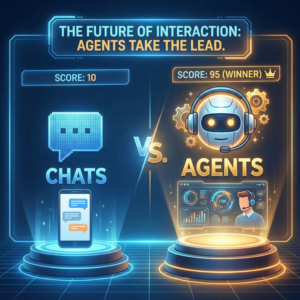
Post by Peter Hanley, coachhanley.com
In the fast-moving landscape of early 2026, the terms “Chatbot” and “AI Agent” are often used interchangeably. However, if you’re using an old-school bot when you need a modern agent, you’re essentially bringing a calculator to a space race. The difference isn’t just a matter of semantics; it’s the difference between a system that talks and a system that works.
As we move from the era of “chatting” to the era of “doing,” understanding this distinction is the key to reclaiming your time and scaling your business.
1. The Bot: The Reactive “Brain in a Room.”
A traditional chatbot—even a smart one—is reactive. It sits in its digital room, waiting for you to walk in and ask a question. Consequently, its utility is capped by your ability to prompt it correctly.
- Logic: It follows “If/Then” scripts or retrieves text from a database.
- Action: It can tell you how to book a flight, but it can’t book the flight for you.
- Memory: Most bots have “amnesia”—they forget who you are the second you close the browser tab.
In addition, bots are primarily about information retrieval. They are perfect for FAQs, but they aren’t going to help you grow your “income area” while you sleep.
2. The Agent: The Goal-Oriented “Digital Coworker.”
An AI Agent is a “Bot with hands.” It doesn’t just process language; it processes intent. When you give an agent a goal, it creates a plan, chooses the right tools (via Model Context Protocol), and executes the work.
- Autonomy: You give it a destination (“Increase my leads by 10%”), and it determines the route.
- Tool Use: Agents can browse the web, log in to your CRM, draft emails, and even use a credit card for approved purchases.
- Proactivity: In 2026, agents don’t wait for you. They monitor your data and say, “I noticed a drop in site traffic, so I’ve drafted three SEO-optimized posts to fix it.”
Furthermore, agents possess a “persistent state.” They remember your project constraints from last Tuesday and apply them to today’s task without being reminded.
3. Head-to-Head: Bots vs. Agents
| Feature | Traditional Chatbot | 2026 AI Agent |
| Philosophy | “Reply to the human.” | “Achieve the goal.” |
| Workflow | Single-turn (Q&A). | Multi-step (Plan-Act-Observe). |
| Integration | Limited (mostly text-in/out). | Deep (connects to APIs, POS, & CRM). |
| Intelligence | Pattern matching. | Reasoning & Chain-of-Thought. |
| Outcome | An answer or a link. | A completed task or deliverable. |
4. Which One is Best for You?
The answer depends on the complexity of your problem. Nevertheless, for most businesses in 2026, the “best” setup is actually a hybrid model.
- Use a Bot for high-volume, low-complexity tasks like giving out store hours or tracking a package. It’s fast, cheap, and low-risk.
- Use an Agent for “Strategic Execution.” This is where the real money is made—repurposing content, managing customer follow-ups, or running your “High-Voltage” lead capture.
Instead of trying to build a massive, complex bot that fails at everything, deploy a fleet of “Micro-Agents.” One agent for research, one for drafting, and one for compliance.
The “Silicon Shift”
We’ve spent the last three years teaching AI how to listen. Now, we are finally seeing it learn how to act. Moreover, the shift to an “Agentic Workforce” means that your job moves from “Executing” to “Orchestrating.” You aren’t just a business owner anymore; you’re a Manager of Autonomous Intelligence.
“In 2026, a chatbot is a luxury for your customers, but an AI Agent is a necessity for your sanity.”
Final Thoughts
Choosing between a bot and an agent is about deciding whether you want an assistant who takes notes or a colleague who takes action. By walking slowly and establishing use cases for agents, you reduce your vulnerability and increase your capacity.

My latest post The digital leap, why we are diving into Chat agents